
Original text published in the column of Cátedra Josué de Castro USP in Nexo Políticas Públicas.
When the World Health Organization (WHO) drafted the International Code of Marketing of Breast-milk Substitutes (here referred to as the “International Code”) in the early 1980s, we could hardly have imagined the brutality we would face in what we now call “digital environments” and everything that inhabits them today: influencers, unboxings, trends, reels, TikTokers, algorithms, and so on. At that time, the obstacles women faced in carrying out what should be a natural practice (although not always an easy one) — breastfeeding their babies — were already enormous, but perhaps somewhat more concrete and explicit than they are today.
“Perhaps” because the practices of misinformation, manipulation, sabotage, and other strategies used by the industry have always been insidious. The dissemination of studies marked by serious conflicts of interest, co-opted health professionals downplaying the importance of breastfeeding, and — of course — tons of aggressive and omnipresent advertising, promotions, and sponsorships endlessly repeating the same promise about infant formulas and other products that compete with breastfeeding: easier, safer, more practical, more nutritious.
In recent years, as we already know, digital environments have added complexity and amplified the reach of thousands of commercial, non-commercial, and who-knows-if-commercial content. Beyond formal sales channels such as websites, advertisements, apps, and e-commerce platforms, there is also an overwhelming volume of images, persistent and personalized messages, multiple testimonials, and other stimuli that (whether intentionally or not) encourage the purchase of products and services. Looking exclusively at online sales, according to Fundação Getulio Vargas (FGV) studies conducted at the end of 2025, they account for 18.7% of the total volume of commerce and continue to grow rapidly every year. Data from the Brazilian Electronic Commerce Association (ABComm) showed that national e-commerce reached BRL 204.27 billion in revenue in 2024, representing a growth of around 10% compared to the previous year. And projections are striking: Brazil is expected to have 110 million online shoppers by 2030.
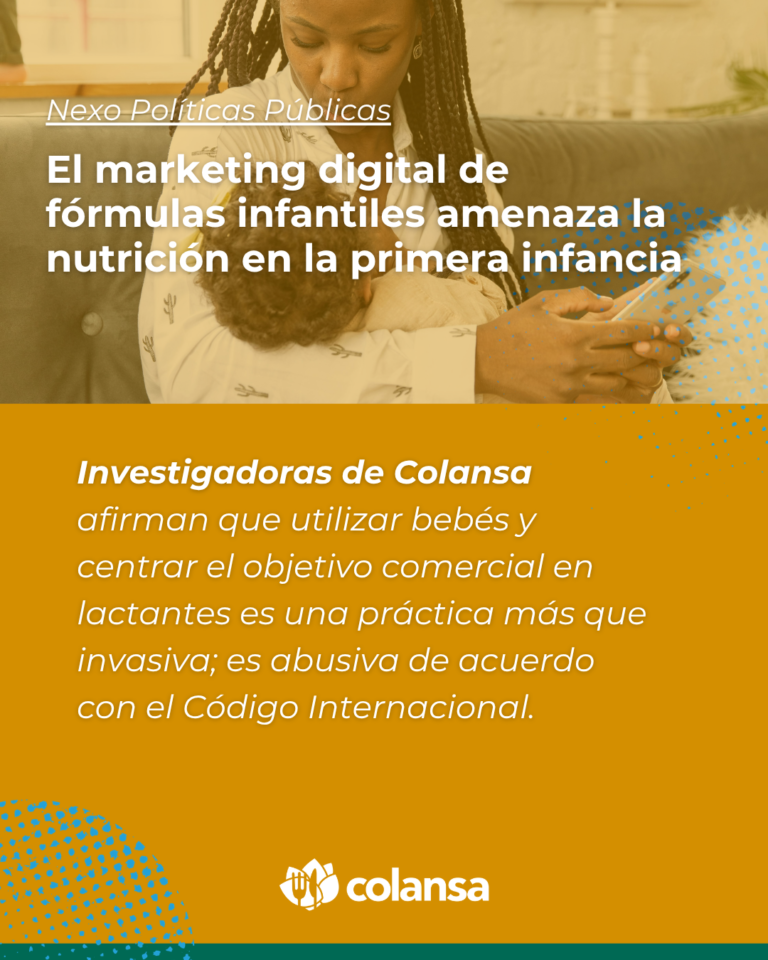
Using newborns and babies and focusing commercial targeting on pregnant women, breastfeeding women, mothers, and caregivers — often when they are feeling vulnerable — are practices that are more than invasive; they are abusive according to both the International Code and the Brazilian Consumer Protection Code.
According to a 2021 WHO global study, infant formula industries not only pay social media platforms and influencers to gain direct access to pregnant women and mothers (offering, among other things, tools such as apps, virtual support groups or “baby clubs,” promotions, and contests), but also publish content on their social media accounts approximately 90 times a day, reaching 229 million users. This represents around three times more people than those reached by informative breastfeeding posts from non-commercial accounts, such as public health agencies or organizations that promote breastfeeding.
Mothers, fathers, families, educators, caregivers, and entire communities feel powerless and disoriented, putting national policies and strategies aimed at promoting breastfeeding at risk — a practice whose benefits for both infant and maternal health are unquestionable. In addition to missing out on these benefits, the inappropriate use of infant formula and other products that compete with breast milk may also bring other potential harms, such as the early introduction of ultra-processed food products, contamination from unsafe water or poorly sanitized utensils, as well as financial impacts, since these products can consume a significant portion of already limited family budgets.
Recently, the Brazilian Health Regulatory Agency (Anvisa) banned the sale of certain Nestlé infant formulas due to the risk of bacterial contamination. A 2024 report by Public Eye also revealed differences between Nestlé products sold in Europe and those sold in the Global South. Researchers found that products marketed in Africa, Asia, and Latin America contained sugar levels far above what is recommended for children under two years old. In Switzerland, however, the same products are free from this ingredient.
The Brazilian Ministry of Health, alongside other countries, civil society organizations, United Nations agencies, and research institutions, has intensified efforts to ensure that certain rules are adopted and that the International Code is respected, including in the face of the ever-emerging new forms of advertising. Last year, the 78th World Health Assembly approved a resolution (proposed by Brazil, Mexico, and other countries) focusing on the regulation of digital marketing, the improvement of monitoring systems, and the restriction of the promotion of these products on social media, apps, and search engines. However, progress in implementation must happen quickly, and cooperation and regulatory harmonization among countries are essential, since digital platforms operate globally. At the same time, laws remain national, often making enforcement and sanctions difficult.
This week, once again, Colansa and Ibfan, together with other civil society organizations, mobilized to draw attention during the 79th World Health Assembly session, demonstrating how episodes of formula contamination have their consequences amplified by digital marketing, adding urgency to this agenda. Among other dangers, digital marketing enables cross-border sales of unregistered products to countries where diagnosis, monitoring, and treatment may not be available.
Breastfeeding provides a powerful line of protection against all forms of child malnutrition and numerous diseases. It must be promoted and defended against all illegal advertising practices — from flyers and promotions at pharmacy entrances to hashtags and pop-ups on our cell phones. It is the duty of governments, with the support of society, to protect public health and confront the necessary challenges to regulate and curb such abuses.